By Neda Ahmad, MD, MHA
If you have lived with back or leg pain for months or years, you have probably heard the phrase “spinal cord stimulator” from a doctor, a friend, or an online forum. For many people, the idea of a device placed near the spine sounds intimidating. That reaction is completely normal.
This article explains what spinal cord stimulation is, who it is meant for, what the process actually looks like, and how to think about whether it is worth it. Our goal is not to sell you on a procedure. It is to give you clear, honest information so you can have a better conversation with your care team.
What is spinal cord stimulation?
A spinal cord stimulator is a small implanted device that sends mild electrical pulses to the spinal cord to change how pain signals reach the brain. It is one type of neuromodulation, a broad term for treatments that adjust nerve activity rather than cutting, fusing, or removing anything.
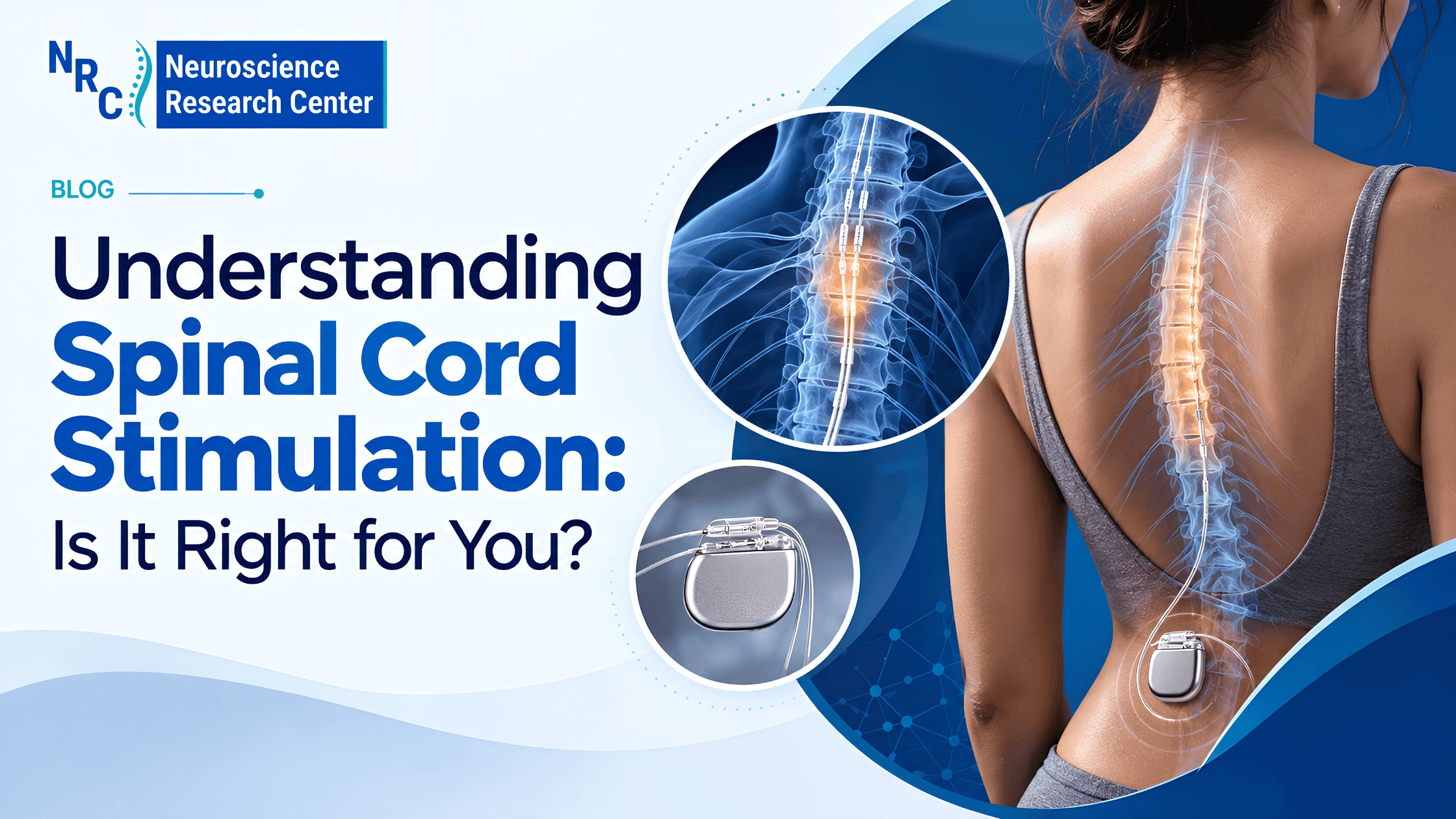
The system has three main parts:
- Leads: thin, flexible wires with small electrodes at the tip. They rest in the epidural space, just outside the protective covering of the spinal cord.
- Pulse generator: a battery-powered unit about the size of a small stopwatch, usually placed under the skin of the upper buttock or lower back.
- Remote control: a handheld device or phone app you use to turn stimulation on or off, adjust settings, and check the battery.
Think of pain signals as traffic traveling up a highway to the brain. Stimulation does not remove the cause of pain. Instead, it changes the traffic pattern so fewer pain messages get through, or so the brain interprets them differently.
Spinal cord stimulation is not new. It has been used since 1967 [1], and the technology has improved a great deal since then. Today’s devices are smaller, longer-lasting, and far more adjustable than early versions.
Who is spinal cord stimulation for?
Spinal cord stimulation is meant for people with chronic pain, especially pain with a nerve component, that has not improved enough with other treatments. It is usually considered after more conservative options, not as a first step.
Conditions where it is commonly used include:
- Persistent pain after back surgery (sometimes called failed back surgery syndrome or persistent spinal pain syndrome) [2]
- Chronic low back pain with or without leg pain (sciatica), including some people who have never had surgery [3]
- Complex regional pain syndrome (CRPS), a nerve pain condition often affecting an arm or leg
- Painful diabetic peripheral neuropathy in the feet and legs, for certain devices approved for this use [4]
- Other chronic nerve pain, as determined by a pain specialist
A typical candidate:
- Has had pain for six months or longer
- Has tried treatments such as physical therapy, medications, and injections without lasting relief
- Is not a good candidate for, or does not want, another major spine surgery Wants to reduce reliance on pain medication, including opioids
- Is willing to complete a psychological evaluation, which is a routine part of the process
It may not be the right fit for people with an untreated infection, a bleeding disorder that cannot be managed, certain spinal anatomy that prevents lead placement, or a need for frequent full-body MRI scans with a device that is not MRI compatible. Your doctor will review these factors with you.
The psychological evaluation often worries people. It does not mean anyone thinks your pain is “in your head.” Chronic pain affects sleep, mood, and stress, and these factors influence how well any pain treatment works. The evaluation helps your team set you up for success.
What does the process look like?
One of the most reassuring facts about spinal cord stimulation is that you get to test it before you commit. Very few surgical treatments offer that.
- Evaluation. A pain specialist reviews your history, imaging, and past treatments. You complete a psychological evaluation and talk through your goals.
- Trial period (usually about 3 to 10 days). The exact length varies by practice and device. Temporary leads are placed through a needle in the back, usually with light sedation and X-ray guidance. No incision is needed for most trials. The leads connect to an external battery worn on a belt. You go home the same day and try the device during your normal routine.
- Decision point. If your pain improves meaningfully, often defined as about 50% or more, and you can do more of what matters to you, you may move forward. If not, the temporary leads are simply removed in the office, and nothing is left behind.
- Permanent implant. Permanent leads are placed in the epidural space through a needle or small incision, and the pulse generator is placed under the skin. Some people need a paddle-style lead, which requires a small surgical opening in the spine and sometimes an overnight stay. This is typically an outpatient procedure, with most people going home the same day or the next morning.
- Recovery. Most people return to light activity within days. For several weeks, you avoid heavy lifting, twisting, and bending so the leads can settle in place. Your care team will give you restrictions specific to your procedure and device.
- Programming and follow-up. A device representative and your care team fine-tune settings over the following weeks and months. Adjustments are made with the remote and require no further procedures.
Types of stimulators
Not all stimulators work the same way. Over the past decade, manufacturers have developed several approaches, and your doctor can help match one to your pain pattern.
| Approach | How it feels | What it means for you |
| Traditional (tonic) | Gentle tingling or buzzing over the painful area | The original approach; some people like feeling it working |
| High-frequency | Usually no tingling | Stimulation runs in the background without a noticeable sensation |
| Burst and other waveforms | Little or no tingling | Pulses delivered in patterns designed to mimic natural nerve firing |
| Dorsal root ganglion (DRG) | Targeted, often minimal tingling | Focuses on specific nerve roots; often used for pain in a limited area such as the foot or groin |
| Closed-loop | Steady, consistent sensation | The device measures your spinal cord’s response and adjusts automatically |
Many modern devices can deliver more than one type of stimulation, so settings can be changed if your needs shift. Some practical details depend on the manufacturer and model, including whether the battery is rechargeable, how long it lasts before replacement, and what MRI scans are allowed. Because of this, experiences and results can vary from one device to another, so ask your doctor about these details for any device you are considering.
A closer look at closed-loop stimulation
One common complaint with traditional stimulators is that the feeling changes when you move. Your spinal cord shifts slightly when you sit, stand, cough, or lie down, which changes its distance from the leads. Stimulation can suddenly feel too strong or too weak, and some people end up reaching for the remote throughout the day.
Closed-loop stimulation was designed to solve that problem. Instead of sending the same signal no matter what, a closed-loop system listens to how your spinal cord responds to each pulse and adjusts the next one automatically, many times every second. The idea is similar to cruise control in a car: the system keeps your therapy steady as conditions change.
What this can mean for patients:
- More consistent pain relief as you move through your day
- Fewer manual adjustments with the remote
- Objective data about how your nerves are responding, which can help your doctor fine-tune your therapy
In a double-blind randomized trial, 82% of patients using closed-loop stimulation reached at least 50% pain relief at 3 months, compared with 60% using standard stimulation, and the benefits held up at 2 years [5, 6]. As with any stimulator, results vary from person to person.
Is the surgery worth it?
There is no single right answer, but for the right person, spinal cord stimulation can be life changing. The trial period exists precisely so you can answer this question with real experience instead of guesswork.
It is also worth knowing that research results vary. Several randomized trials show strong benefit for specific conditions [2–5]. However, a 2023 Cochrane review and a placebo controlled trial found smaller or no lasting benefit for some types of back pain [7, 8], and pain specialists have challenged some of those conclusions [9, 10]. This is one more reason the trial period matters: it shows you how the therapy works for you.
Potential benefits
Meaningful reduction in pain for many people who have run out of other options
Better sleep, mobility, and ability to work, exercise, or enjoy family time Less need for pain medication, including opioids, for some patients [7] A reversible treatment: the device can be turned off or removed
A minimally invasive procedure compared with major spine surgery
Possible risks
Like any procedure, spinal cord stimulation carries risks. Serious complications are rare, but about 1 in 3 people have at least one complication, most often a hardware issue that can be fixed with a follow-up procedure [1]:
- Infection at the implant site
- Lead movement, which happens in about 1 in 10 people and usually requires a minor revision procedure [11]
- Discomfort where the battery sits
- Hardware problems over time
- Pain relief that lessens over time for some people; changing settings or stimulation type can sometimes restore it, but some devices are eventually removed for this reason [12, 13]
- Rarely, a spinal fluid leak causing headaches, or nerve injury [1]
Questions to ask your doctor
- What results have your patients with pain like mine experienced?
- Which type of stimulation do you recommend for me, and why?
- How will we measure whether the trial is successful?
- Will I be able to get MRI scans in the future?
- How often will the battery need charging or replacing?
- What does my insurance cover?
The bottom line
Chronic pain can make life feel smaller, and it is easy to lose hope after trying treatment after treatment. Spinal cord stimulation is not a cure, and it is not right for everyone. But it is a well-established, adjustable, and reversible option that has helped many people get back to the things they care about.
If you are wondering whether it might help you, the best next step is simply a conversation. Ask your pain specialist, or reach out to our team to learn more about spinal cord stimulation.
Contact: Neuroscience Research Center or Kansas Pain Management · 913-339-9437
This article is for educational purposes only and is not medical advice. Please talk with your healthcare provider about the treatment options that are right for you.
References
- Eldabe S, Buchser E, Duarte RV. Complications of spinal cord stimulation and peripheral nerve stimulation techniques: a review of the literature. Pain Med. 2016;17(2):325-336. doi:10.1093/pm/pnv025
- Kumar K, Taylor RS, Jacques L, et al. Spinal cord stimulation versus conventional medical management for neuropathic pain: a multicentre randomised controlled trial in patients with failed back surgery syndrome. Pain. 2007;132(1-2):179-188. doi:10.1016/j.pain.2007.07.028
- Kapural L, Jameson J, Johnson C, et al. Treatment of nonsurgical refractory back pain with high-frequency spinal cord stimulation at 10 kHz: 12-month results of a pragmatic, multicenter, randomized controlled trial. J Neurosurg Spine. 2022;37(2):188-199. doi:10.3171/2021.12.SPINE211301
- Petersen EA, Stauss TG, Scowcroft JA, et al. Effect of high-frequency (10-kHz) spinal cord stimulation in patients with painful diabetic neuropathy: a randomized clinical trial. JAMA Neurol. 2021;78(6):687-698. doi:10.1001/jamaneurol.2021.0538
- Mekhail N, Levy RM, Deer TR, et al. Long-term safety and efficacy of closed-loop spinal cord stimulation to treat chronic back and leg pain (Evoke): a double-blind, randomised, controlled trial. Lancet Neurol. 2020;19(2):123-134. doi:10.1016/S1474- 4422(19)30414-4
- Kapural L, Mekhail NA, Costandi S, et al. Durable multimodal and holistic response for physiologic closed-loop spinal cord stimulation supported by objective evidence from the EVOKE double-blind randomized controlled trial. Reg Anesth Pain Med. 2024;49(4):233-240. doi:10.1136/rapm-2023-104639
- TraegerAC, Gilbert SE, Harris IA, Maher CG. Spinal cord stimulation for low back pain. Cochrane Database Syst Rev. 2023;3(3):CD014789. doi:10.1002/14651858.CD014789.pub2
- Hara S, Andresen H, Solheim O, et al. Effect of spinal cord burst stimulation vs placebo stimulation on disability in patients with chronic radicular pain after lumbar spine surgery: a randomized clinical trial. JAMA. 2022;328(15):1506-1514. doi:10.1001/jama.2022.18231
- Durbhakula S, Broachwala MY, Schuster NM, McCormick ZL. Striking errors in the methodology, execution, and conclusions of the Cochrane Library review of spinal cord stimulation for low back pain by Traeger et al. Pain Med. 2023;24(8):923-925. doi:10.1093/pm/pnad047
- Gyorfi M, Pillai I, Abd-Elsayed A. Spinal cord stimulation efficacy and erroneous conclusions of the Cochrane Library review of spinal cord stimulation for low back pain by Traeger et al. Brain Sci. 2023;13(8):1181. doi:10.3390/brainsci13081181
- West T, ElSaban M, Hussain N, et al. Incidence of lead migration with loss of efficacy or paresthesia coverage after spinal cord stimulator implantation: systematic review and proportional meta-analysis of prospective studies and randomized clinical trials. Neuromodulation. 2023;26(5):917-927. doi:10.1016/j.neurom.2023.03.016
- Hagedorn JM, Lam CM, D’Souza RS, et al. Explantation of 10 kHz spinal cord stimulation devices: a retrospective review of 744 patients followed for at least 12 months. Neuromodulation. 2021;24(3):499-506. doi:10.1111/ner.13359
- Provenzano DA, Park N, Edgar D, Bovinet C, Tate J. High-frequency (10 kHz) spinal cord stimulation (SCS) as a salvage therapy for failed traditional SCS: a narrative review of the available evidence. Pain Pract. 2023;23(3):301-312. doi:10.1111/papr.13184